
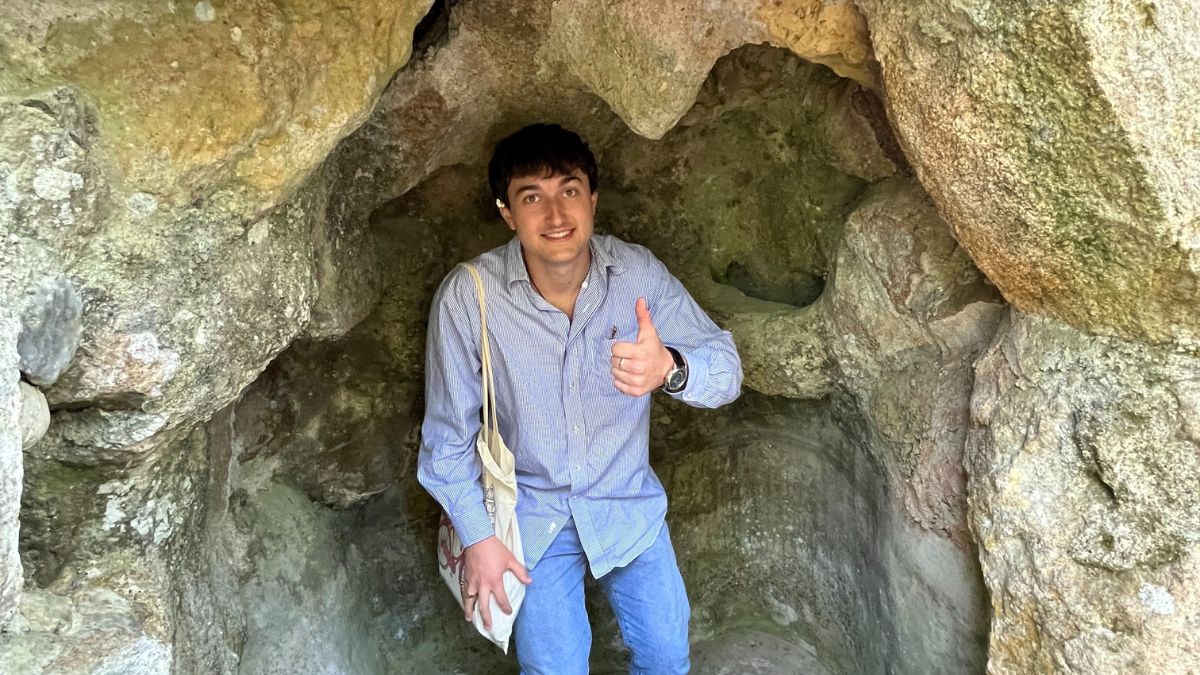
Eager to step into the footsteps of a college student who studied abroad in Spain? We recently caught up with AIFS Abroad program participant Elias from the University of Vermont who’s studying political science and environmental studies. He spent a spring semester studying abroad in the Andalusian city of Granada.
Read on to learn more about his study abroad experience with AIFS Abroad and the impact of being an international student in Granada.
Choosing a Study Abroad Destination & Term
Choosing where and when to study abroad can be a tough decision for study abroad students. With AIFS Abroad there are so many amazing destinations to choose from, offered throughout the year. Elias landed on Granada because he wanted to study abroad in a smaller city in Spain, as he explains:
“I chose to study in Granada because I wanted to go to a city in Spain that I had not been to yet which was smaller and would give me the chance to become fluent in Spanish via immersion. I loved how walkable the city was, which made it easy to get to school, explore the city, and go anywhere else without having to worry about transportation. I would recommend this particular program to students who are looking for a relatively smaller group of students to go abroad with and want to learn about Andalusian culture, food, and history.”
The seasonal climate in their prospective host city is something everyone should consider before they choose a program destination. While some people love warm weather, Elias said he prefers a cooler climate:
“I chose to go abroad for the spring semester of my junior year because I wanted to be in southern Spain when the climate was the mildest. I struggle a bit with extreme heat so I did not think that being in Granada in August would be the right fit for me and I am glad that I did this because I still got to experience the spring season in Andalucia without being too uncomfortable. Another benefit of going to Granada from January to May is that there is generally less tourists during those months (with the exception of La Semana Santa leading up to Easter).”
Overcoming Study Abroad Nerves
Studying abroad can be a bit daunting at first. You’re probably going to a country you’ve never been to before, and you may be setting out on your own. But despite these feelings, study abroad students consistently report that these experiences are worth any nervousness or anxiety. Once you get settled into your program, make new friends, and become more familiar with your host city, those feelings often disappear. Hear Elias describe his own experience with study abroad nerves and overcoming culture shock:
“I definitely had some concerns beforehand going in. I think it’s something that probably a lot of people worry about—the whole kind of culture shock and getting used to living in a foreign country is really challenging. So, I wasn’t really sure how I was going to adapt to that once I got there, especially because I was in a homestay. I got to stay with a host mom who only spoke Spanish. And I was nervous about how strong my Spanish would be and how that would hold up there. I hadn’t taken a Spanish class since high school until I got in there.
For me, culture shock presented itself in the form of my daily routine. I was very accustomed to having so much school and work that I rarely get a chance to do anything else, but I found myself having far more free time in Spain than I was used to. Partially because I had a lighter course load, but mostly because Spanish culture puts far more of an emphasis on having a healthy work-life balance. Even though it took me a little bit to get used to this and to figure out how to fill that time, I miss that every day now that I am back in the U.S.”

Housing
All AIFS Abroad programs include housing, and some of them, like Elias’s, offer the option to live with a host family in a homestay. Below, Elias describes this experience:
“I lived in a homestay for the duration of my semester abroad and absolutely loved it. It took a couple weeks until I really felt settled in and fully comfortable being there, but my host mother was so kind that I never felt like I was intruding in her home at all. The best thing students can do when they first get to their homestays is—even if there is a language barrier—get to know your host family as much as possible. This lets them know that you’re grateful to be living in their home and it will also help you feel more like you are living with extended family rather than strangers.”
Finances & Budgeting
Many study abroad students have to weigh their finances before they decide to study abroad. Fortunately, AIFS Abroad accepts financial aid packages[GU1] , as long as your university approves. Also, AIFS Abroad offers scholarships & grants that can reduce the cost of studying abroad.
In addition to program costs, you should consider how much you’ll spend while you’re abroad and budgetaccordingly, as Elias did:
“I worked as much as possible in the several months leading up to going abroad so that I could use some of that money to travel on the weekends and although it was difficult to do this, it was absolutely worth it. I set a plan ahead of time of exactly how much money I would allot myself for each kind of expense such as food, travel, and nightlife and stuck to that plan pretty consistently. For students planning to go abroad in the near future, I absolutely recommend getting creative in finding the most inexpensive ways to travel such as overnight buses, trains, and budget airlines when necessary.”
Application & Paperwork
If you’re in the process of studying abroad, you know that there’s some paperwork you need to do before you can set out to your study abroad destination. In addition to filling out an application (which we promise is as painless as possible!), you may need to apply for a visa. As Elias said, the visa was his least favorite part about pre-departure:
“The most stressful part of leading up to actually studying abroad would be getting a visa… It’s a lot of paperwork, but it’s absolutely worth it. Once you actually get there and experience what study abroad really is, it makes all the stress leading up to the program worth it.”
Additionally, AIFS Abroad makes the process simple—we can help you get your visa and fill out all of your paperwork, as Elias explains:
“One of the things that helped me with trying to get through all the annoying paperwork and logistics and everything beforehand are the resources and people you can reach out to at AIFS, and I highly recommend doing that, especially with visa stuff. I had a lot of questions about that like, ‘When am I going to get my visa back?’ and ‘Am I doing this paperwork right?’ Don’t be afraid to reach out to the people that are there to help you because they usually have the answers to your questions.”
Why AIFS Abroad?
Besides our pre-departure, application, and visa support, there are a whole lot of other reasons to choose AIFS Abroad! For example, many students love the support of our on-site staff, our valuable program inclusions like trips and excursions, safe and central housing, plus our many high-quality programs located all around the world. For students who want a supportive, immersive, and fun study abroad experience, choosing AIFS Abroad is a no-brainer. Hear Elias explain why he chose AIFS Abroad:
“I chose AIFS because I knew that they would help make the application process as seamless as possible and ensure that I get the most out of my study abroad experience. I loved that they have locals direct each program so that students can learn directly from them about their city and have an easy transition into life in a new country… They were definitely more involved with our program and directly supporting us when we arrived in Spain, more than I was expecting. Having all the orientation activities was really helpful, getting to meet people in our program helps you get to know the city and where you live and everything. It made it a lot easier to adjust to living there… I also appreciated that AIFS programs are affordable and offer many scholarships to make their programs as accessible as possible to everyone.”
Academics Abroad
Studying abroad provides valuable academic opportunities in addition to cultural experiences. During your program you can take unique courses, gain a local perspective on subject matter, and learn in a totally new environment. Hear Elias describe his university experience in Granada:
“I studied in the Center for Modern Languages in the University of Granada. I was very grateful that the directors of my program gave everyone in the group a detailed map of where each of the two buildings in the school were located so that we could easily find them. Both buildings were very easy to get to, were kept very clean, had reliable internet access, and had a very relaxing ambiance. This helped me focus on my studies while in class without being distracted by noise on the street or anything else.”
Below, Elias elaborates on his courses in Granada and how local perspectives on subjects enriched his learning:
“I was able to take a few political science classes while I was there, one of them was an Environmental Politics of the [European Union] class. The other one was the Political Systems of Spain and the [European Union], which are not topics you would get to study back in the U.S. It’s also being taught from the perspectives of professors that are directly impacted by those things and have grown up learning about it and studying it. So that was really cool. It was a chance to learn about things within my major in niches that I wouldn’t usually find here at [a] college [in the U.S.]”
While you are not required to know or learn a second language to study abroad, some select programs do require you take a language course. For many students this is an excellent opportunity to pick up some basic language skills, and, like Elias, complete some GenEd requirements:
“I was required to take a Spanish grammar and a Spanish speaking and writing class. That was amazing as well because for part of my program here at UVM I’m required to take a certain amount of foreign language courses. So, it helped me fulfill that, but also it helped me get a lot better at speaking Spanish, which was one of my biggest goals. Probably my number one goal for studying abroad was to try to become fluent in Spanish. Part of that was through taking those classes and part of it was also just through being in a homestay and living in a city where everyone speaks Spanish. So that cultural exposure is a big part of it too.
That Spanish speaking class… [taught me] the ability to learn conversational Spanish—some slang and some other phrases that [locals] actually use, so [I wasn’t] talking like a robot. It helps you blend in when you’re having conversations with native speakers. That’s a really cool thing that you’re probably less likely to get [in the U.S.]”
Cultural Appreciation & New Perspectives
When you study abroad you get to immerse yourself in a new culture, which can open you up to new experiences, ways of life, and perspectives. Hear Elias explain how his perspective changed during his time in Granada:
“[My perspective] definitely changed a lot. Part of it was that I got to learn a lot about other cultures. There were a lot of students there that were not just from the U.S., but from other countries, too. Having the chance to meet people from all around the world helps to develop that broader worldview. Also, having the ability to travel during that time helps a lot. It changes a lot about the way that you view your life when you come back to the U.S. There [are] a lot of things about living here that we either just take for granted or assume are universal. And it’s really different when you come back here. And I think part of that difference is a work-life balance. That’s something that’s very different culturally between the U.S. and the rest of the world. So being exposed to things like that and just seeing what the style of living is like in another country can really change how you view your own life when you come back here. And it can change how you go about your daily life.
I think that one thing I noticed, especially in Europe in general, is that there’s more of an emphasis on just quality of life and happiness over making money. I guess the best way to put it is there are other ways to find success. And that was a really big way that my perspective changed. I miss living in that kind of environment now that I’m back [home].”
What Makes Studying Abroad So Special?
Every student who studies abroad has a different experience, but among all these differences is one common thread—a life-changing experience that stays with you forever. Hear Elias describe what he believes makes the study abroad experience so special, and what Granada means to him:
“I would say the immersion that you have in living there makes it so amazing. You get to feel like you’re just like a local there. [You adapt] so quickly, and you become a Granadino. Like you just kind of settle in, and once you get used to it, it’s so cool.
Just getting to experience the culture there… it’s the kind of thing that you can never learn the same way out of a textbook. Like you can learn about what a ‘sobremesa’ is, but you don’t really know what it is until you do it, which is getting to have a long conversation with your family and friends after [a meal]. But it’s just things like that are so different when you get to experience it firsthand. And those are the kinds of things that really stick with you, and it’ll be different in every place that you go to.
But the other big thing is obviously getting to meet people there… We got to meet so many amazing people… And whether it’s owners of the local coffee shop or local bar, I think the biggest memories that still stick with me today when I think about Granada are actually going around and thinking about how we’re going to say goodbye to those people within the last few weeks of studying abroad there. And it’s crazy to think we were only there like four months. Like how in four months can you become so settled in a place, so attached to a place that then leaving feels like you’re saying goodbye to a place you’ve known your whole life? So, I think about the last night there and kind of going around and just seeing all of our favorite spots again. I think part of it’s the people and part of it’s the culture.”
Elias’s Advice for Studying Abroad
For anyone considering studying abroad or who’s getting ready to set out, Elias offers the following advice:
“To start with, if there is a student who is kind of on the fence about studying abroad and you’re not really sure, take that leap of faith. I was very nervous about [studying abroad]… I didn’t know what [program was] right for me. You’re not going to have all the answers right away and you’re not going to know exactly what a study abroad program will look like. But sometimes it’s good to just find a programthat you think will suit you and just take that leap of faith and just go for it. Because a lot of things you’ll figure out when you get there… you don’t have to have everything planned out… That’s part of the journey and part of the whole beauty of getting to do this. If you think it’s something that you could do and you’re on the fence about it, go for it. I hear a lot more people say that they regret not doing it than regret doing it. It’s worth the risk.
And when you’re there, squeeze everything out of it that you can, because I know people say like, ‘It’s going to fly by.’ But seriously, I cannot believe I was there for four months. It felt like probably four weeks. It goes by so quickly… And it’s not like you take your life at home and transplant it into a new country and you’re just doing the same thing in another country. It’s seriously like your life literally changes. You change. So, it’s kind of scary, but it’s also such an amazing thing at the same time…
And when it comes time for you to leave, allow yourself to feel sadness, joy, or whatever emotions may come up because it is just par for the course. Best of luck and I wish you all the best in your journey!”
Are you a student who’s ready to take the leap and study abroad like Elias did in Granada? We’d love to help you start your journey!
Here at AIFS Abroad, we know a thing or two about helping college students and pre-professionals study and intern abroad. Our programs are incredibly inclusive, which takes a lot of the stress out of planning. From coordinating your housing to providing things like cultural and social activities, excursions, comprehensive insurance, 24/7 emergency support, on-site staff, and more, you’ll take comfort in knowing you’ll have support throughout your entire experience abroad.