

When you study or intern abroad, travel quickly becomes part of everyday life—whether that’s commuting within your host city, heading out on a weekend adventure, or planning a multi-day excursion during a school or holiday break. For many AIFS Abroad students and interns who rely on transportation abroad, trains become the go-to way to get around, offering a travel experience that’s not only convenient, but also immersive, affordable, sustainable, and less stressful. Below, we explore some of the advantages of taking the train during your study or intern abroad program and how it can transform the way you travel.
“If I didn’t take the train on daytrips or weekend trips, I would not have had the time to [travel] because of how convenient the train is and always located in places I needed and wanted to go (often at much cheaper prices as well). I learned to appreciate the beauty of slower travel and find the small adventures (and the food cart) while traveling.”—Addison, who did a study abroad program in Prague, Czech Republic
Don’t derail your travel goals: discover how you can make the most of your time abroad by taking the train!
Convenient and Traveler-Friendly
Trains aren’t just for commuting locals who know the schedule and stations by heart; they’re also a great option for tourists and travelers. Unlike airports, they’re often located right in the city center—making them more convenient to reach, especially when you’re already using public transportation, as AIFS Abroad alum, Maggie, who studied abroad in Budapest put it:
“One other bonus of the trains is that they are usually very centrally located in the cities, especially compared to the airports, so it is easy and fast to get to them using public transportation like buses, trams, and subways.”
That central access makes trains ideal not only for big trips, but also for spontaneous day trips and weekend travel—all without the added time, cost, or stress of airport logistics.


Less Stress, More Time
Speaking of stress…even the most veteran travelers can feel a little strained going to (and through) the airport. Chances are, the airport is located outside the city center, so you have to take a bus, train, or taxi, and leave loads of time to get through hectic check-in and security lines, then race through unfamiliar terminals in search of your gate.
“Taking the train was easier than flying. No hour uber to the airport, no long wait times, no delays, no TSA, and no stress.”—Gabby, who did a study abroad program in London, England
For many students, like Maggie, taking the train becomes a welcome break from the rush of travel that lets you slow down and let off some steam:
“Over my semester [abroad], I spent 38 hours on trains and wouldn’t have traded it for the world. It allowed me to relax, not worry about airport security or baggage, see incredible views of the countryside, and, of course, complete any homework or studying so that I could enjoy my time away in a new place!”
With plenty of space to stretch out, read, listen to music, or get a head start on schoolwork, trains turn travel time into something that adds to your experience, rather than taking away from it.

Added Comfort
Speaking of stretching out, comfort is another big benefit of train travel. On a train you may have more room than on a packed budget airline or a bus. Whereas flights are frequently filled up (or overbooked), that’s not always the case with a train, providing you with more room for your bags and your personal space.
Plus, on those longer journeys, it’s easy to get up and stretch your legs on a train compared to a bus or airplane where aisles are often too narrow to walk around comfortably. On a train you can pace around your car, stand by the doors and take a quiet phone call, or walk the length of the train (no reason not to get your steps in!). Additionally, some trains have a cafe on board where you can go to get a hot cup of coffee or a snack while you watch the views pass outside the window. Not to mention, there will likely be more accessible bathrooms on a train than a plane—and certainly more than a bus—without the risk of unexpected turbulence making you rush back to your seat.
Even flying first class or ordering a private car doesn’t spare you from the hassle of traffic and airport lines. Train travel, by contrast, can offer comfort from start to finish.
Cost-Effective for Longer Trips
Train travel can be surprisingly budget-friendly, especially when you’re moving between multiple cities or traveling for longer periods of time. While budget airlines may seem appealing and affordable at first glance, additional fees like checked bags can add up quickly. Plus, there’s the cost of getting to the airport in the first place.
Maggie noted how trains made a longer fall break trip from Budapest to Florence, Lucerne, Amsterdam, and Brussels, possible:
“While there are tons of budget airlines with very reasonable ticket prices, I would have had to pay for a bigger bag to fit enough clothes for eleven days without laundry and take five planes. With my Eurail Pass, the only additional cost was a seat reservation, which was only required on some routes. I started planning my fall break trip on the Interrail Planner app and decided to hit four cities: Florence, Lucerne, Amsterdam, and Brussels.”
For students like Maggie who have enjoyed free access to the Eurail Global Pass through AIFS Abroad, the flexibility makes it easier (and cheaper!) to plan multi-city trips without constantly rebooking transportation. If you’re not eligible for a Eurail Pass through AIFS Abroad, buying a similar multi-day pass can still save you big on longer trips with multiple legs.

Ideal for Commuting and Inter-City Travel
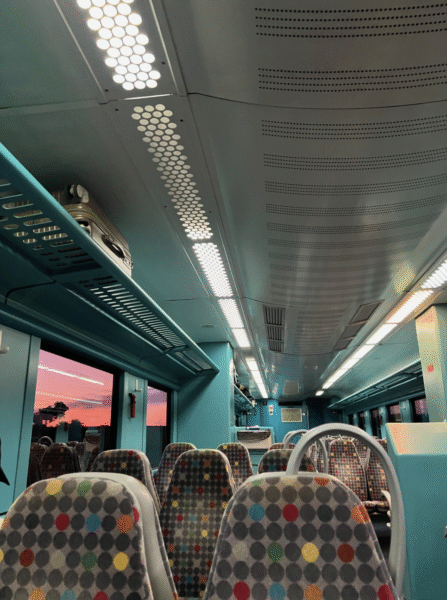
Trains aren’t just an option for those longer international excursions, they’re often the ideal choice for shorter trips as well. Many cities have large train networks that make it easy to get around your program destination. Whether you’re commuting from your dorm to your internship or classes abroad, or you’re spending a Saturday afternoon exploring a new neighborhood, taking the train is often faster and more convenient than taking a bus or taxi.
Mid-distance trips to nearby cities are where trains truly shine. Too short a trip to take a plane and a bit too long for a bus; trains are perfect for inter-city travel—allowing you to explore your host country on a budget and take quick day trips during your free time.

Scenic and Immersive
Oftentimes, getting from point A to point B feels like a chore: something you just have to get through if you want to reach your destination. But with train travel—especially in exciting international destinations—it’s an experience in and of itself. Ketina, an AIFS Abroad alum who did a study abroad program in Salamanca, Spain, echoed how trains transformed travel into a meaningful part of her experience:
“One of my favorite travel experiences was a long train journey that took me from Amsterdam, Netherlands, to Montpellier, France, and then from Montpellier to Salamanca, Spain. What could have been just a way to get from one place to another turned into one of the most meaningful parts of my time in Europe. It was my first time using trains in Europe, and it completely changed how I think about travel. Instead of rushing to my destination, I got to slow down and experience the journey itself.”

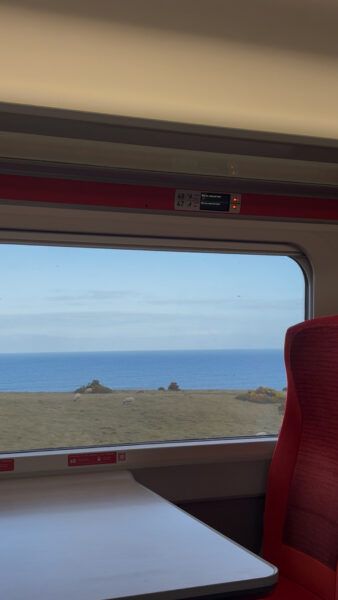
Unlike planes or buses, where there may only be views of clouds or highways, trains offer uninterrupted views with their large windows that everyone—no matter their seat—can see. This may mean rolling countryside landscapes, quaint towns, and a quick insight into the life and environment of the country outside its big cities and tourist destinations.
“Taking the train through countrysides and between huge city destinations gives you a new perspective of [the country] [and its] way of life. On trains, there are giant windows that can be shared by multiple people. On planes, not everyone gets a window seat, and if you do, you either have the sun blaring onto your skin or complete darkness… On a train, everybody gets a window seat. The window is like a movie screen, and travelers are simply watching a really long movie. This makes the journey feel much faster.”—Caitlin, who did a study abroad program in Cannes, France

A More Sustainable Way to Explore
Traveling by train is also more sustainable than other forms of transportation, particularly flying, producing significantly fewer emissions per passenger. As part of the AIFS Abroad Green Initiative, we encourage students to take trains over planes, especially for shorter trips. While always sticking to trains may not be feasible, using them as your preferred option for local and regional travel allows students and interns to explore responsibly while reducing their environmental impact.
Choosing trains is a simple choice that supports sustainable travel—without sacrificing convenience or adventure.
“Since my first discovery of the convenient trains along the Mediterranean Sea, I’ve been hooked. It’s so easy just to [travel to another] city to participate in exciting festivals, try new foods, see new sights, and try new activities. Once the European train doors open, a world of new possibilities and emotions opens as well.”—Caitlin
Keep your travel on track—choose the train as you study or intern abroad with AIFS Abroad!
Whether it’s for your daily commute to classes or your internship abroad, a weekend getaway, or a once-in-a-lifetime trip across multiple countries, train travel offers convenience, comfort, and connection—making it a favorite among AIFS Abroad students and interns. And with built-in support, trusted on-site staff, included housing, and award-winning programs, you’re free to take a breath, stretch your legs, and focus on the journey ahead. Ready to discover where an AIFS Abroad program will take you?