
Designated by the United Nations Educational, Scientific, and Cultural Organization (UNESCO) for having “outstanding universal value” to humanity, UNESCO World Heritage Sites are some of the world’s most celebrated natural, historic, and cultural treasures. For study abroad students, visiting these sites is an excellent way to further immerse yourself in the local culture and history of your host city and experience unique destinations that exist nowhere else on Earth. And for students who study abroad with AIFS Abroad, some of these remarkable sites are easily reachable via a short drive, a train ride, or (in some cases) just steps from your door.
Discover the UNESCO World Heritage Sites you can explore when you study or intern abroad with AIFS Abroad.
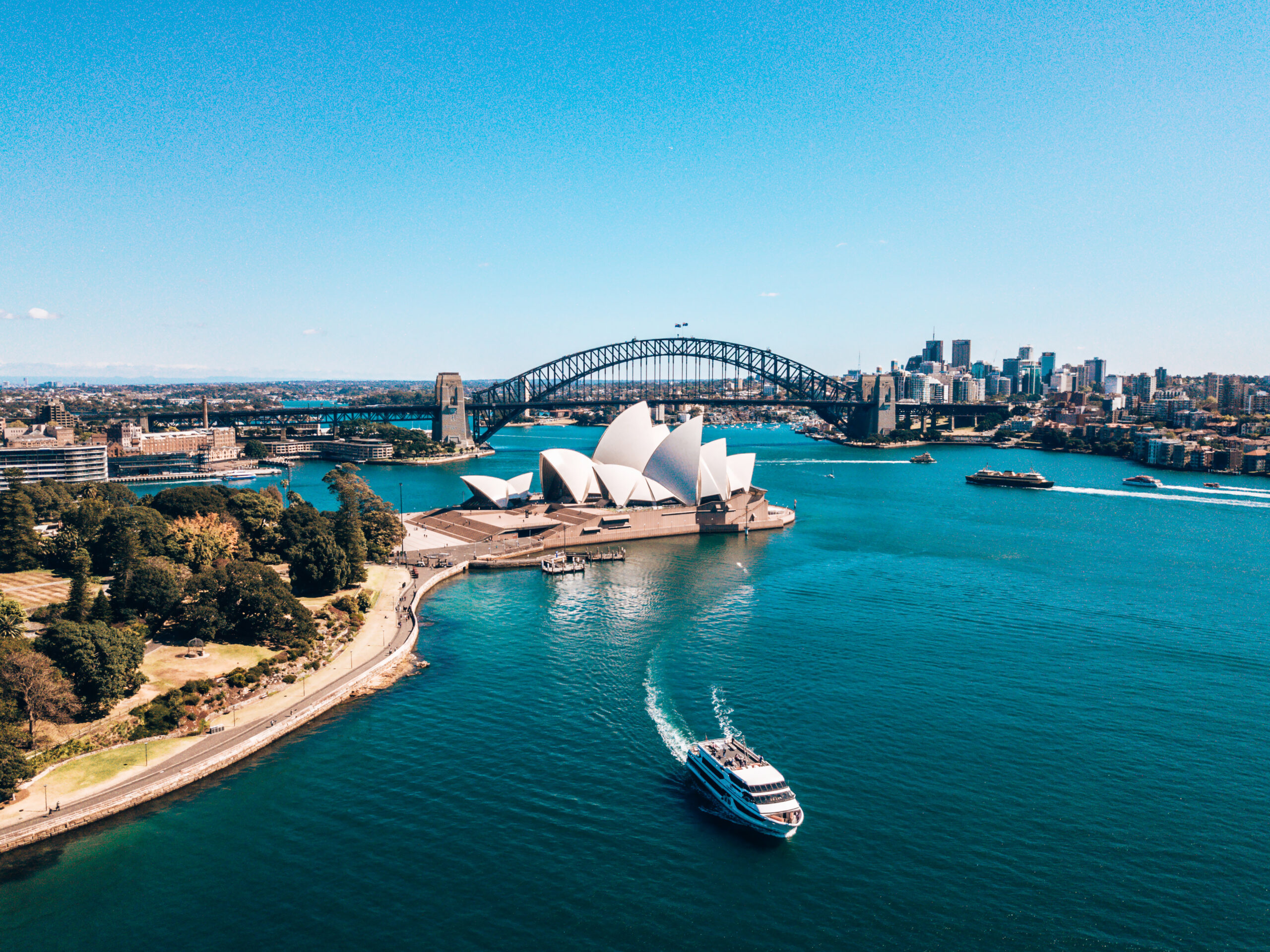
Sydney Opera House — Sydney, Australia
One of the most recognizable buildings on Earth, the Sydney Opera House earned UNESCO status in 2007 for its architectural brilliance and cultural significance. Designed by Danish architect Jørn Utzon and inaugurated in 1973, it remains a masterpiece of 20th-century design and a beloved musical venue. Whether you’re attending a performance or appreciating the view from the harbor, the Opera House is a sight that study abroad students in Sydney won’t want to miss.
Australian Convict Sites (Fremantle Prison) — Perth, Australia
Fremantle Prison, along with ten other Australian convict sites, was listed as a UNESCO World Heritage Site in 2010. Located in the Perth metropolitan area, Fremantle Prison is one of the many penal sites established by the British Empire on Australian soil in the 18th and 19th centuries. Between 1787 and 1868, over 150,000 men, women, and children were condemned by the British and sent to the “convict colonies.” The Fremantle Prison offers students a deeper look into Australia’s history and how European powers used large-scale convict transportation to expand their empires.

ESMA Museum and Site of Memory — Buenos Aires, Argentina
Once a notorious detention center during Argentina’s military dictatorship (1976 – 1983), Escuela Superior de Mecánica de la Armada (ESMA) was named a UNESCO World Heritage site in 2023. The building stands as a reminder of Buenos Aires’s complex past and the crimes against humanity committed during Argentina’s “Dirty War.” It’s a powerful human rights museum where visitors can learn about one of the darkest chapters in 20th-century Latin America.
Historic Centre of Salzburg — Salzburg, Austria
Home to a plethora of well-preserved architecture across the ages, including picturesque Baroque palaces and striking Gothic cathedrals, the Historic Centre of Salzburg is sure to transport you back in time. Its iconic skyline, punctuated by towers, spires, and domes set against the backdrop of the Austrian Alps, is alone worth the UNESCO designation. For students studying abroad in Salzburg, it’s an extraordinary opportunity to learn more about how centuries of cultural and artistic influence shaped one of the most beautiful cities in the world.

Costa Rica — Área de Conservación Guanacaste
Northwest of San José, on the Pacific coast, is the Área de Conservación Guanacaste, one of Costa Rica’s most significant UNESCO World Heritage Sites, recognized for its outstanding biodiversity and role in tropical dry forest conservation. For students passionate about environmental science, ecology, or sustainability, it represents one of the most ambitious conservation projects in the Americas and is a natural extension of Costa Rica’s world-leading commitment to protecting the natural world.
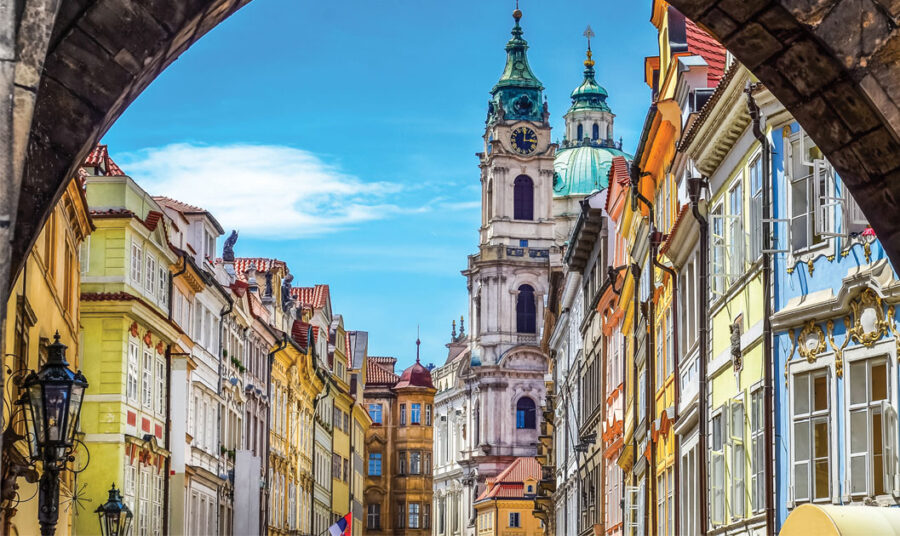
Historic Centre of Prague — Prague, Czech Republic
Prague’s historic center—encompassing Prague Castle, Charles Bridge, the Old Town Square, and the Jewish Quarter—was inscribed as a UNESCO World Heritage Site in 1992. Few cities on earth wear their history as visibly as Prague, where Gothic, Baroque, Renaissance, and Art Nouveau architecture coexist in one extraordinary urban landscape. For students of history, architecture, and European culture, every cobblestone street is like a living classroom, and every facade is a unique lesson.
The Galápagos Islands — Ecuador
The Galápagos Islands are one of the world’s most celebrated and earliest UNESCO World Heritage Sites. Inscribed in 1978, this remote volcanic archipelago inspired Charles Darwin’s Theory of Evolution through natural selection. Today, the islands remain one of the planet’s most biodiverse and carefully protected ecosystems, home to species found nowhere else on Earth. For college students who want to dive into fields like marine biology and conservation, you can’t do much better than a study abroad program in the Galápagos Islands.
Tower of London — London, England
Built on the Thames by William the Conqueror in 1066 as a demonstration of Norman Power, the Tower of London has served as a royal palace, fortress, prison, and treasury since it was constructed almost a thousand years ago. A UNESCO World Heritage Site since 1988, it’s home to the Crown Jewels, legendary ravens said to protect the kingdom, and stories of royal executions that shaped history. It offers a fascinating peek into Britain’s medieval past and is one of the most visited monuments in London, if not the world.
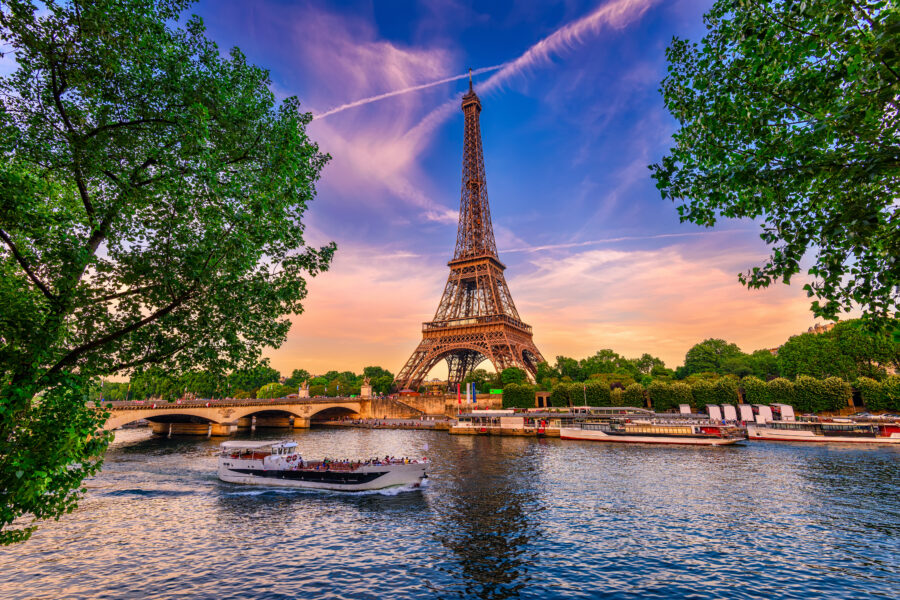
Palace of Versailles / Banks of the Seine — Paris, France
Paris alone has multiple UNESCO sites, but the Banks of the Seine, inscribed in 1991, captures the city’s unparalleled concentration of cultural landmarks in a single designation, including Notre-Dame, the Eiffel Tower, the Louvre, and more. Students who study abroad in Paris are also just a short journey from the Palace of Versailles, another UNESCO site—a grand expression of French royal power, aristocratic extravagance, and the place where the treaty that ended World War I was officially signed.
Historic Site of Lyon — Grenoble
Just beyond the picturesque mountains that surround Grenoble is the UNESCO World Heritage Site of Lyon. This historic city was founded by the Romans in the 1st century B.C. and named the Capital of the Three Gauls, which was a region comprising much of Western Europe. Since its founding, Lyon has continued to play important social, economic, and political roles in the region and the world at large. Crossed by the Rhône and Saône rivers and sprawling with countless historic buildings, the city has a certain je ne sais quoi that study abroad students in Grenoble can easily experience for themselves.
Nice, Winter Resort Town of the Riviera — Cannes & Antibes
Less than 20 miles from Cannes, and even closer to Antibes, is the coastal city of Nice, which was inscribed as a UNESCO World Heritage Site in 2021 for its unique architectural legacy and as the world’s first great winter resort. From the 18th century onward, European aristocracy flocked to its sunny shores, leaving behind a remarkable blend of Baroque Italian, Belle Époque, and distinctly Niçois architecture that still defines the city today. For AIFS Abroad students in Cannes and Antibes, it’s an easy and beautiful day trip along the French Riviera.
Museum Island — Berlin, Germany
Situated on a small island in the heart of Berlin, Museum Island is a UNESCO World Heritage Site comprising five world-renowned museums: the Altes Museum, the Neues Museum, the Alte Nationalgalerie, the Bode Museum, and the Pergamon Museum. Inscribed in 1999, the site represents one of the most phenomenal concentrations of art, archaeology, and cultural history in the world. As an entire island dedicated to human knowledge and creativity, it’s truly something to behold—and offers something of interest to everybody.
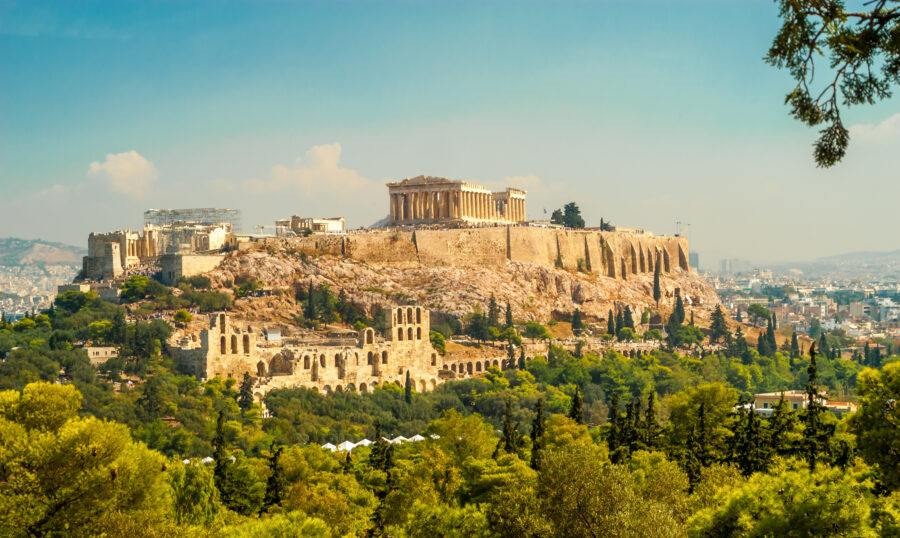
Acropolis of Athens — Athens, Greece
Towering over the city on its rocky plateau, the Acropolis of Athens is one of the most iconic and significant archaeological sites in the world. Home to the Parthenon, the Erechtheion, and the Temple of Athena Nike, this UNESCO World Heritage Site represents the birthplace of democracy, philosophy, and civilization in the Western world. As such, studying abroad in Athens is an ideal place to enjoy one of history’s greatest monuments as the backdrop to your studies.
Budapest — Budapest, Hungary
Budapest’s UNESCO designation encompasses the sweeping Banks of the Danube, the Buda Castle Quarter, and Andrássy Avenue. Home to the remains of the Roman city of Aquincum and the Gothic Buda Castle, alongside the shimmering waters of the Danube, this site forms one of Europe’s most breathtaking and historic urban landscapes. Whether you’re looking to admire beautiful architecture or learn more about the Hungarian capital, easy access to this UNESCO site is one of the many benefits of studying abroad in Budapest.
Brú na Bóinne — Ireland
Added to the UNESCO World Heritage List in 1993, Brú na Bóinne is host to three prehistoric passage tombs just 30 miles north of Dublin. Known as Newgrange, Knowth, and Dowth, these Neolithic tombs are over 5,000 years old and predate the Egyptian pyramids by more than 500 years. It’s an excellent place to learn more about Ireland’s ancient past, which laid the foundation for the Celtic traditions the country is famous for today.
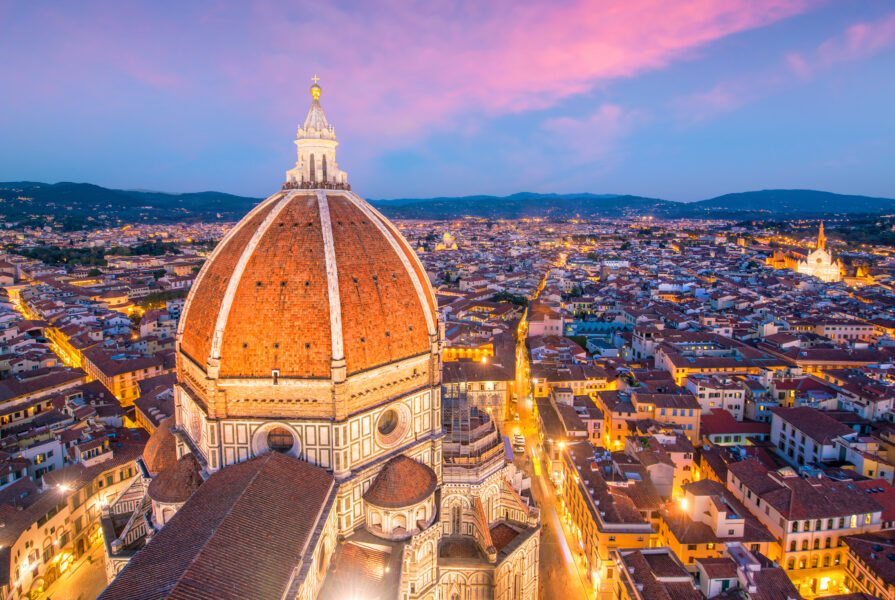
Historic Centre of Florence — Florence, Italy
The Historic Centre of Florence is one of the most recognizable UNESCO World Heritage Sites in the world. As the birthplace of the Renaissance and the home of the Uffizi Gallery, the Duomo, the Palazzo Vecchio, and works by Michelangelo, Botticelli, and Leonardo Da Vinci, it is a veritable sanctuary for many of the world’s most prized artistic and ecclesiastical pieces. Students fortunate enough to study abroad in Florence will find many of these treasured artworks and architectural buildings within walking distance from their classrooms and housing.
Church of Santa Maria delle Grazie (The Last Supper) — Milan, Italy
Milan’s UNESCO claim is one of the most singular in the world: the Church and Dominican Convent of Santa Maria delle Grazie, which holds one of Da Vinci’s most prized masterpieces, The Last Supper. Painted between 1495 and 1497 on the refectory’s north wall, it is one of the most studied, admired, and reproduced works of art in human history. Whether you’re studying art history or looking for some creative inspiration, it’s a sight you won’t want to miss when you study abroad in Milan.
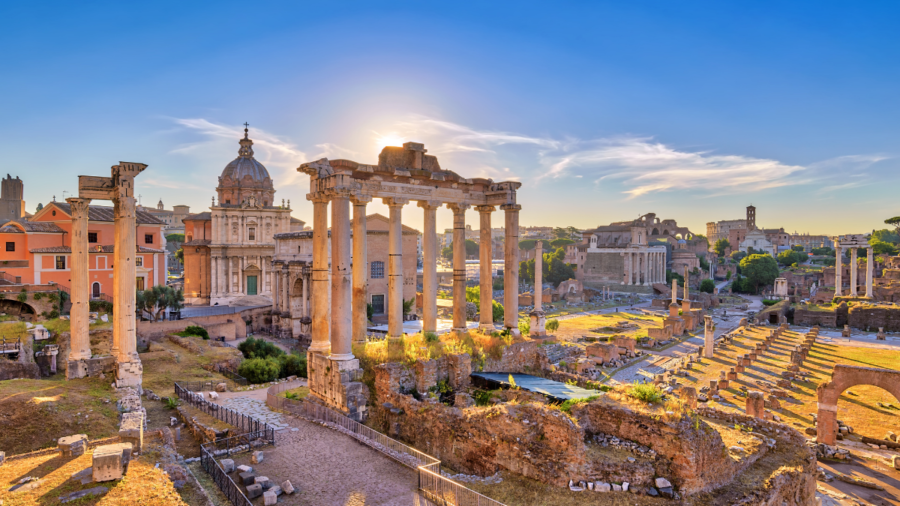
Historic Centre of Rome — Rome, Italy
Packed with ancient ruins, stunning architecture, and immense religious significance, it is no wonder the Historic Centre of Rome is a UNESCO World Heritage Site. Extended to the walls of Urban VIII in 1990, Rome’s expansive designation includes the historic district, the Vatican, and the Basilica of San Paolo Fuori le Mura—a sweeping recognition of a city that served as the center of the Western world via the Roman Empire and the Papacy. The Colosseum, the Roman Forum, the Pantheon, and the Sistine Chapel all fall within this designation, making Rome one of the most historically dense UNESCO sites on the planet–and intertwining everyday student life with thousands of years of history.

Kinkaku-ji / Nijo Castle — Kyoto, Japan
Home to an astonishing 17 UNESCO World Heritage Sites, Kyoto is one of the most historically significant cities in Japan. Two standout sites include Kinkaku-ji (Golden Pavillion), an opalescent Zen Buddhist temple covered in gold leaf, and Nijo Castle, the former residence of the first Tokugawa shogun and a symbol of Japan’s feudal past. Together, these landmarks offer students studying abroad in Kyoto a unique opportunity to explore centuries of Japanese religious, political, and cultural history in a city where the past remains deeply connected to daily life.
Sintra Cultural Landscape — Lisbon, Portugal
Just a short drive from Lisbon is the Cultural Landscape of Sintra, named the first center of European Romantic architecture in the 19th century and a UNESCO World Heritage Site in 1995. This unique environment blends local and exotic tree species and natural landscapes with a diverse display of Gothic, Egyptian, Moorish, and Renaissance architecture to create a unique mix of the manmade and earthly that is like no other.
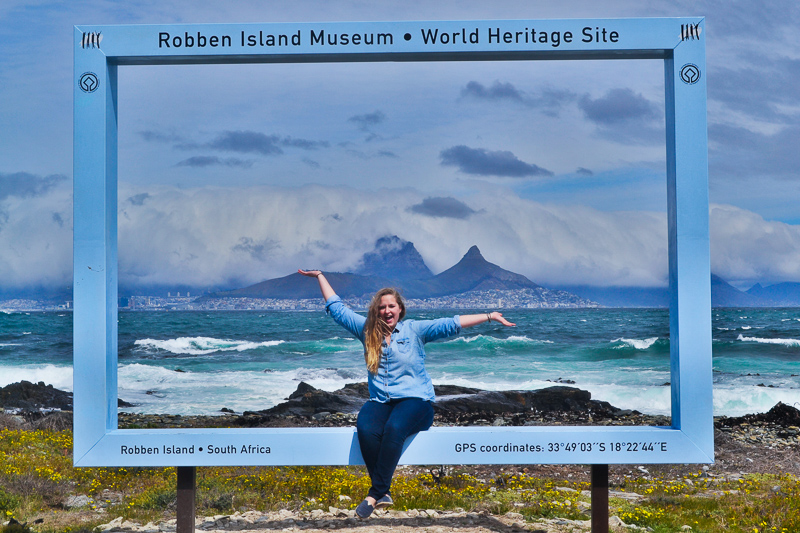
Robben Island — Stellenbosch, South Africa
Take a brief bus ride to Cape Town from Stellenbosch, then hop on a 30-minute ferry ride to discover Robben Island, one of South Africa’s most significant UNESCO World Heritage Sites. Most famous as the prison where Nelson Mandela spent 18 of his 27 years of incarceration, the island is now a powerful museum and symbol of the struggle against apartheid and the triumph of democracy. A visit to Robben Island will deliver a moving and educational experience that will deepen your understanding of South African history and society during your time abroad.
Changdeokgung Palace Complex — Seoul, South Korea
Built in the early 15th century, Changdeokgung Palace is one of South Korea’s most beloved UNESCO World Heritage Sites and one of the finest surviving examples of Joseon Dynasty architecture. What sets it apart is the palace complex’s harmonious relationship to nature. The official and residential buildings were integrated into the natural environment, and its celebrated Secret Garden (Huwon) is a beautifully preserved royal garden of pavilions, ponds, and ancient trees tucked behind the palace walls. Together, the palace and garden offer a rare and intimate window into Korea’s royal heritage right in the heart of the city.
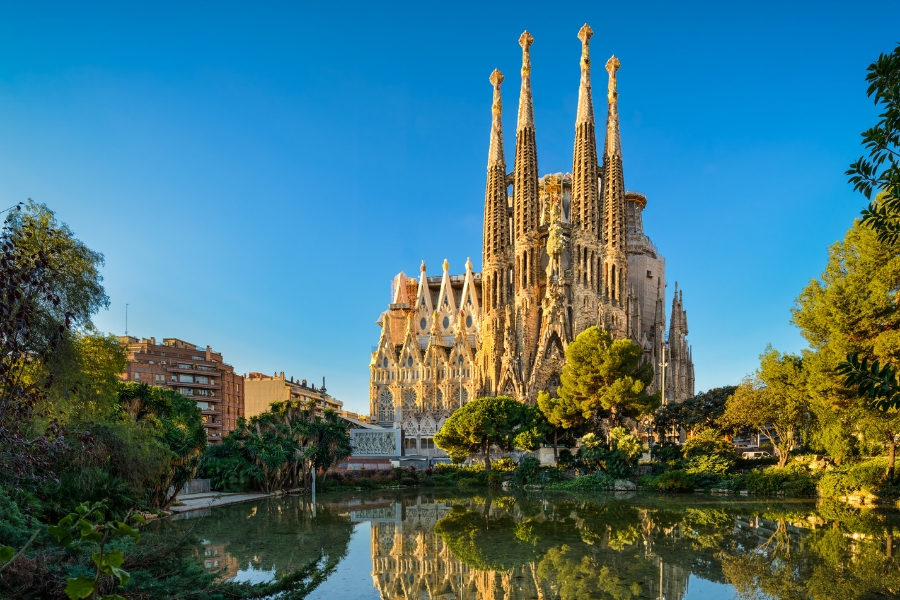
Works of Antoni Gaudí — Barcelona, Spain
Seven properties designed by the renowned architect Antoni Gaudí are named UNESCO World Heritage Sites in and around Barcelona. The properties are known for their eclectic, colorful, and striking designs that truly set them apart. Park Güell, for example, is like a Technicolor fairyland tucked into the city’s urban streets, while the recently completed La Sagrada Familia is defined by its imposing spires that crown the city’s skyline. Studying abroad in Barcelona gives college students plenty of time to explore each of Gaudí’s works in detail and appreciate them in a different light.
Alhambra, Generalife, and Albayzín — Granada, Spain
Rising above Granada’s lower town, the Alhambra and Albayzín form the medieval heart of the city. The Alhambra is one of Spain’s most iconic landmarks—a Moorish fortress whose red-tinged walls set against the snow-capped Sierra Nevadas make for one of the most striking silhouettes in all of Europe. The Albayzín is Granada’s oldest neighborhood, a labyrinth of whitewashed houses that transport you back to the Nasrid Dynasty under which they were built, between the 13th and 15th centuries. Rounding out this remarkable trio, the Generalife served as the summer palace and estate of the Nasrid rulers, celebrated for its elegant architecture and beautifully manicured gardens.
El Escorial — Madrid, Spain
Just 30 miles northwest of Madrid, El Escorial is one of Spain’s grandest UNESCO World Heritage Sites. Commissioned by King Philip II at the height of the Spanish Empire, this vast 16th-century royal monastery, palace, and mausoleum is one stop you won’t want to miss when you study abroad in Madrid. A monument to the power of the Spanish Crown and the Catholic Church, it houses one of the finest libraries in the world and the tombs of Spanish monarchs spanning four centuries.
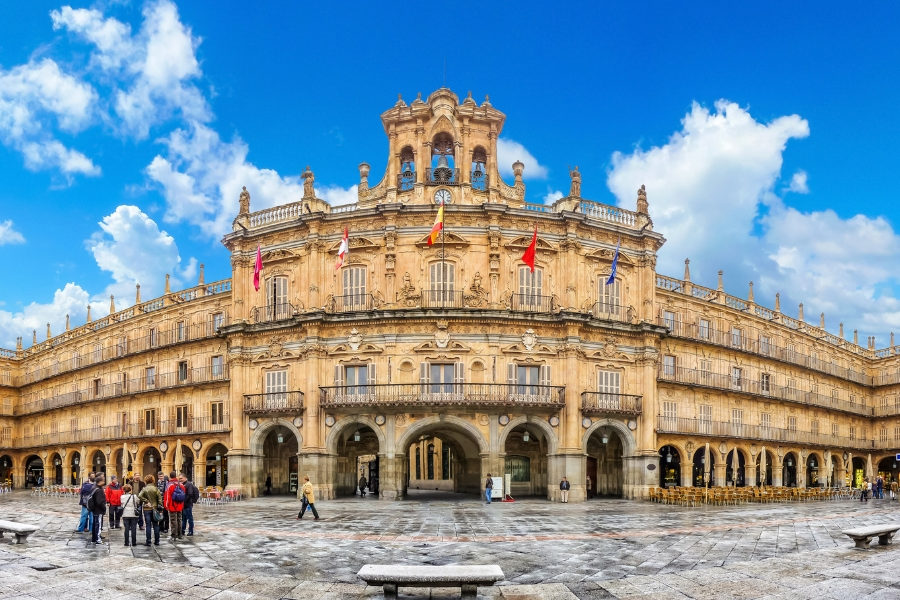
Old City of Salamanca — Salamanca, Spain
Often called “The Golden City” due to its captivating sandstone architecture, which glows golden in the sunlight, this UNESCO World Heritage Site is one of undeniable beauty. Centered in the historic city center and on one of Europe’s oldest and most celebrated universities, founded in 1218, the Old City of Salamanca is a place of deep history and far-reaching academic tradition. Students who are lucky enough to study abroad in Salamanca can admire the unforgettable architecture between classes and enjoy a university experience unlike any other.
Cathedral, Alcázar, and Archivo de Indias — Seville, Spain
Seville’s UNESCO triumvirate tells the story of a city that was once the gateway to the New World. This World Heritage Site includes the Seville Cathedral, the largest Gothic building in the world and the burial place of Christopher Columbus; the Royal Alcázar, an awe-inspiring Moorish palace still used by the Spanish royal family; and the Archivo de Indias, which houses the most comprehensive collection of documents on Spain’s colonization of the Americas. Study abroad in Seville to immerse yourself in the history of Spain’s Golden Age and to experience the stunning vestiges of its Islamic influences and colonial power.
La Lonja de la Seda (Silk Exchange) — Valencia, Spain
La Lonja de la Seda (Silk Exchange) is a magnificent late Gothic civil building constructed between 1482 and 1533 as a symbol of the city’s immense commercial power during the height of the Mediterranean silk trade. Its soaring twisted columns, ornate carvings, and grand trading hall make it one of the finest examples of secular Gothic architecture in Europe, and a testament to Valencia’s long history as a city of culture and commerce.
Ready to explore these UNESCO World Heritage Sites in person? With an AIFS Abroad study abroad or internship program, they’re closer than you think.
Each UNESCO World Heritage Site on this list tells a different story: some whisper of long-past civilizations; others are natural wonders that remind us what’s worth protecting; and all of them lend a historical context for the local cultures that still thrive in and around them. When you study abroad with AIFS Abroad, these stories become part of your own, building on your life experience, and expanding how you see the world.
See some of humanity’s most treasured cultural, historic, and natural sights with AIFS Abroad. Discover which of our programs is calling you.